It’s possible to plant an apple tree without harboring dreams of an orchard.
– David Sylvian
As a child of two working parents, I spent a lot of time in the care of my aunt Betty, and my two grandmothers. They all had pianos, and Auntie Betty also had an organ. What I loved about the piano and organ was that all you had to do was press a key to make a sound that sounded good. It only sounded bad if the sequence of notes played weren’t right. This gave me the courage to try making melodies, just by listening and remembering what worked. I didn’t learn to play songs, but I played. I wanted to make music, so I figured out how to make something musical.
Sometimes, I would come up with a sort of song—a few two-note chords, and a notes that sounded good with them. I played the cycle of chords over and over, and I’d improvise the melody. No idea what key I was in, or if or when I went out of key. I’d always play very slow songs, so that I could work out what I was doing at a slow pace. I tended to keep the sustain pedal down so that there would never be silence while I decided what to do next. The notes would linger patiently, slowly fading, until I chose my next note. It was dramatic music. It’s true that I enjoyed slow, sad, melancholic songs—but really I just didn’t have the skill to play faster/happier. Sometimes I played with my forehead resting on top of the piano. I must have looked like an 8-year-old washed-up piano man contemplating suicide after a long tortured music career failure—wincing as I took a swig of my 7-Up.
Sometimes I’d record my improvisations with a small portable Radio Shack tape recorder—mostly because I had no way to notate what I was doing. If I didn’t record it I’d forget what I had played by the next day.
At age 13 I took piano lessons, and stuck with it for a couple years; but by age 15 I preferred spending time with my girlfriend rather than practicing piano. So, I quit. I learned enough to know that I could be good at playing if I just practiced. The disappointed face of my piano teacher after I told him I was quitting is still very clear in my memory. Ed Cupman was his name, and he was a great, kind and patient teacher. To this day, I’m sorry that I didn’t fulfill the potential I believe he thought I could have achieved. I didn’t regret my decision to quit though. I was free to choose, and I made my choice. However, I did feel some shame that I was not the kind of person I wished I was—one who was single-minded about being great at something by working hard at it. Instead I was single-minded about doing whatever I wanted to do at any moment, and free to change my mind when I lost interest or simply became distracted. I prefer exploration and experimentation more than achievement. Maybe I’m just not very disciplined, or I’m afraid of doing what it takes to succeed. True as that may be, it’s also true that learning and discovery in and of themselves have always been more fun and interesting than what I can do with the things I’ve learned and discovered.
At age 19, I got a Casio CT-660 keyboard at a department store. It had an option to digitally record and play back a performance. This enabled me to play chords first, along with a pre-programmed Casio rhythm, then play back that recording while I played melody—because I didn’t have the skills to do that all at once. I would then record that combined performance with a tape deck, as if I were really playing a song.
One day I discovered with the correct cable, I could plug the Casio’s headphone output to an auxiliary input in my parents JVC stereo amplifier, which had its own input level. A magical thing happened when the input level was too high: distortion. Suddenly my cheesy Casio sounds became unworldly jagged squeals, howls, and roars. My next purchases were a Tascam Portastudio 424 4-track recorder, and an Alesis SR-16 drum machine. With technology and ingenuity, I was working around my limitations as a musician, and recording lots of music—barely listenable as it may have been.
A few years later I upgraded to a Korg O1/W sample playback keyboard and workstation. “Sample Playback” meant it had a lot of realistic sounding sampled instruments on it, like strings and horns, that enabled me to make more orchestral soundtrack-style music. It also had a 16-track sequencer and had 32-note polyphony (able to play 32 sounds at once).
I was 25 when I took a digital sound class in college, which introduced me to digital sampling and software production using Logic Audio. Sampling, of course, allows you to make music out of other people’s music!
Now I’m nearing my 48th birthday, which means I’ve been making music in some form or another for about 40 years. I’ve never done anything with it, meaning I’ve never tried to be professional*, and I’ve rarely shared my music with anyone. It embarrasses me. It’s not good enough. I don’t know anything about music theory. I barely even know how to identify what key I’m playing in. I know there’s an art to sound mixing that is frustratingly illusive to me. I know enough about writing songs to know my songs are not good enough for people to really want to listen to—like the way people listen to music for enjoyment and enrichment. If anything, people who hear the music I’ve made might like it enough to say, “Hey, that’s not bad”, “you’ve got something there”, “that one needs a vocal”. It’s not good. It might have potential, maybe.
However, the music I’ve made is a significant part of who I am, and even my closest friends and family don’t know about it. This blog is about changing that. I’ll be posting links to songs I’ve recorded and writing some thoughts about the songs, what went into making them, and the creative process in general.
*Actually, it’s not true that I’ve never done anything professional with my music. I believe it was around 1992 that a friend, Pejman Hakimi, and I, made a background music song for a dance-club scene in a short erotic sci-fi film called “Hennessy“, which aired on the Playboy Channel.
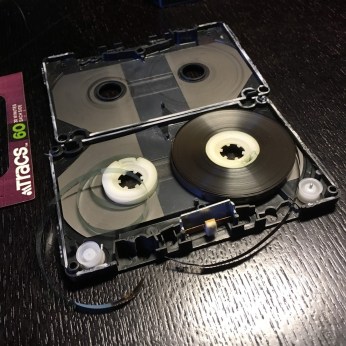 Cassette tapes aren’t too difficult to gently crack open in a way that they can still be put back together. I did this once to make a tape loop (which was my first attempt at primitive sampling—more about that in a future post).
 Cecil Seaside